
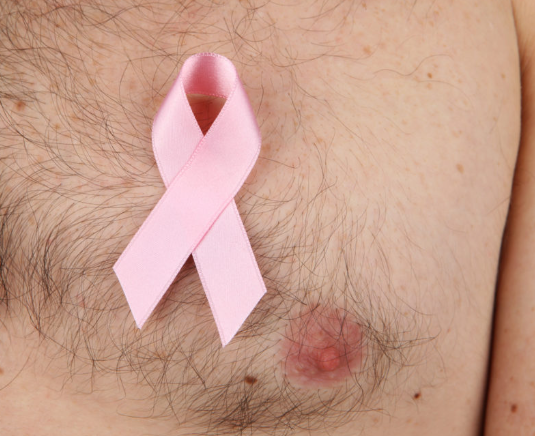
Men can develop breast cancer, though it accounts for less than 1 percent of all breast cancer cases worldwide. The disease typically presents between the ages of 60 and 70 and most often appears as a painless lump beneath the nipple. Male breast tissue is limited but contains the same ducts and cells that can turn cancerous, which is why early signs in men deserve the same urgency as in women.
According to Prof. Dr. Sandeep Nayak, Surgical Oncologist in Bangalore, India, “Male breast cancer gets diagnosed late far too often. Men don’t expect it, GPs don’t always think of it, and by the time the lump is checked, the cancer has already moved into the lymph nodes. The biology isn’t very different from women, but the delay almost always is.“
What Causes Breast Cancer in Men?
Male breast cancer follows a few distinct biological patterns that pathology and family history usually clarify before treatment.
- Genes- BRCA2 mutations are the strongest inherited driver in men, carrying a roughly 6 to 8 percent lifetime risk, while BRCA1 and PALB2 mutations also raise risk and warrant genetic testing when family history is significant.
- Hormones- A higher oestrogen-to-testosterone ratio sits at the centre of male breast cancer risk, which is why conditions like Klinefelter syndrome, chronic liver disease and obesity, all linked to higher oestrogen, raise the risk noticeably.
- Age- Risk climbs steadily with age and peaks between 60 and 70, since older male breast cells, like female ones, accumulate the genetic damage that drives malignant change over time.
- Radiation-Chest radiation given for earlier cancers, especially in childhood or young adulthood, raises long-term breast cancer risk in men and warrants closer surveillance through structured diagnosis and staging protocols.
A clear family history of breast, ovarian or prostate cancer is one of the strongest pointers towards genetic testing in men.
How Is Male Breast Cancer Diagnosed and Treated?
Diagnosis follows the same imaging and biopsy pathway used in women, while treatment is shaped by tumour biology and disease extent.
- Lump. A painless, firm lump under or near the nipple is the most common presenting sign in men, often accompanied by skin retraction or nipple inversion that gets dismissed for months before evaluation.
- Imaging. Mammography is still the first-line imaging in men despite limited breast tissue, with ultrasound used alongside it and biopsy of any suspicious area confirming the diagnosis before treatment is planned.
- Surgery. Most men undergo modified radical mastectomy because the small volume of breast tissue makes breast-conservation difficult, with sentinel lymph node biopsy or axillary clearance done at the same setting.
- Therapy. Around 90 percent of male breast cancers are hormone-receptor-positive, which makes tamoxifen the standard adjuvant choice, with chemotherapy and targeted therapy added based on stage and HER2 status.
Outcomes in men match those in women when stage at diagnosis is comparable, and our blog on early detection explains why timing of evaluation, regardless of gender, decides the surgical pathway.
Why Choose Dr. Sandeep Nayak for Breast Cancer Care in Bangalore?
Dr. Sandeep Nayak brings over 20 years of surgical oncology experience, DNB qualifications in Surgical Oncology and General Surgery, an MRCS from the UK and a fellowship in Laparoscopic and Robotic Surgical Oncology to breast cancer care at KIMS Hospital, Bangalore. He’s the recipient of the K Subhramanyam Robotic Innovation Award 2023 and serves as Executive Director of Surgical Oncology and Robotic Surgery, with originator credits for advanced minimally invasive techniques and over 25 published clinical studies.
Male patients are evaluated with the same diagnostic rigour as women, taken through tumour board review and offered a treatment pathway built around tumour biology, stage and genetic status. Each plan is built case by case, not from a generic protocol. Call +91 8035740000 to book your consultation.
Reference
How common is breast cancer in men?
Male breast cancer accounts for less than 1 percent of all breast cancer cases worldwide.
What is the most common sign of breast cancer in men?
A painless firm lump under or near the nipple is the most frequent early sign.
Are men with BRCA2 mutations at higher risk?
Men carrying BRCA2 mutations have a 6 to 8 percent lifetime risk of breast cancer.
Is treatment for male breast cancer different from women?
Treatment follows similar principles, with mastectomy and tamoxifen being standard for most cases.
Reference
- National Cancer Institute — Breast Cancer Symptoms
- World Health Organization — Breast Cancer Fact Sheet
Disclaimer: The information shared in this content is for educational purposes and not for promotional use.