
What is Antibody-Drug Conjugate (ADC) Therapy and how does it act?
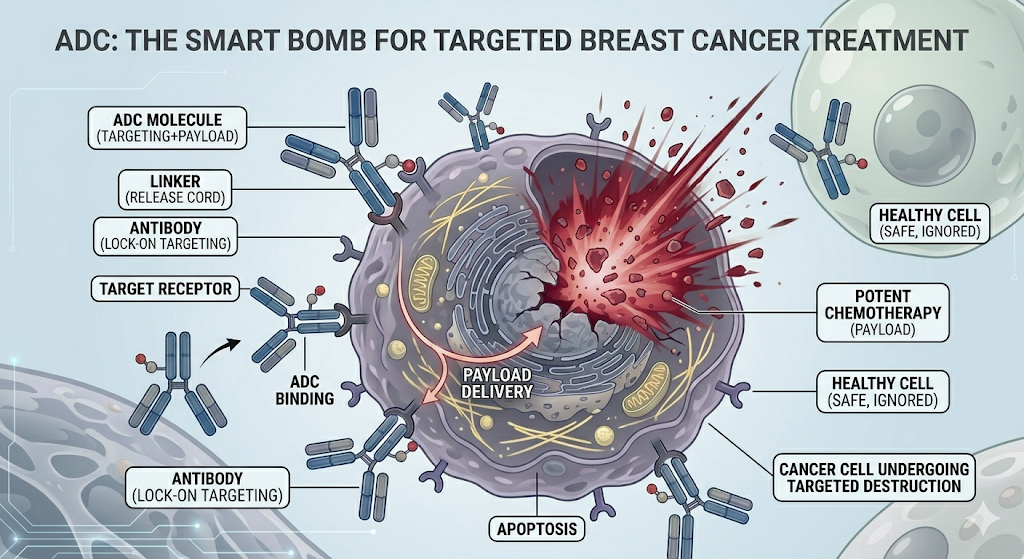
An Antibody-Drug Conjugate (ADC) is one of the most exciting breakthroughs in cancer care today. To understand how it works, think of it as a microscopic “smart bomb”.
Traditional chemotherapy is like a broad-stroke approach—it attacks cancer cells, but it also affects healthy cells, which causes the familiar side effects like hair loss and severe fatigue. An ADC changes the game entirely. It consists of three parts:
- The Antibody (The Homing Device): A specialized protein designed to seek out and lock onto specific markers (receptors) found only on the surface of breast cancer cells.
- The Chemotherapy (The Payload): A highly potent cancer-killing drug.
- The Linker: A chemical bridge that connects the drug to the antibody.
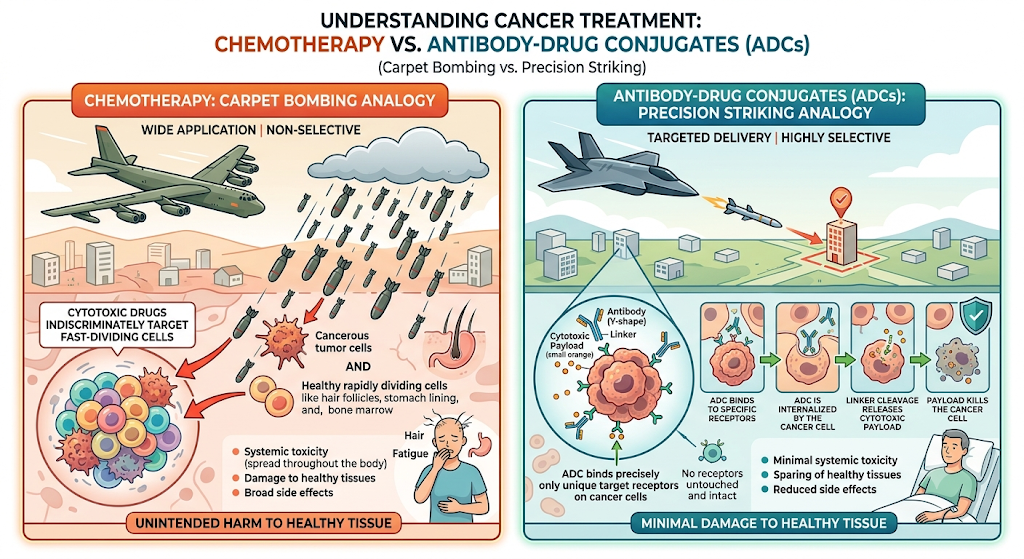
When the ADC enters the body, the “homing device” searches specifically for the cancer cells, completely ignoring healthy tissue. Once it locks onto the tumor, the cancer cell absorbs the ADC. Only then is the powerful chemotherapy released inside the cancer cell, destroying it from within.
Who is a Candidate for ADC Therapy in Breast Cancer?
Crrently, ADCs are primarily used for patients with metastatic breast cancer (cancer that has spread to other parts of the body) or for cancer that cannot be removed by surgery. They are generally used when tumors stop responding to initial hormone therapies or standard chemotherapy.
However, because these drugs are so effective, doctors are increasingly using them earlier in the treatment journey. For example, ADCs are sometimes given after surgery if there is residual cancer left behind from initial treatments, significantly lowering the chance of the cancer ever returning.
What Are the Advantages of ADCs Over Traditional Chemotherapy?
The targeted nature of ADCs provides several powerful benefits:
- Pinpoint Accuracy: By delivering chemotherapy directly into the cancer cell, ADCs can use much stronger, more effective cancer-killing drugs than your body could tolerate through standard IV chemotherapy.
- Overcoming Resistance: ADCs often work brilliantly even in patients whose cancer has stopped responding to traditional treatments.
- Sparing Healthy Cells: Because the drug isn’t released until it is inside the tumor, it limits the collateral damage to the rest of the body.
What are the ADCs available?
There are several incredible ADCs currently transforming the way we treat breast cancer.
Here are four of the most prominent, along with striking data from the clinical trials that led to their approval:
- Trastuzumab emtansine (Kadcyla): This drug targets tumors with the HER2 protein. In the landmark KATHERINE trial, given to patients who still had residual cancer after their initial treatments and surgery, Kadcyla reduced the risk of the cancer returning or death by an astonishing 50% compared to standard targeted therapy.
- Trastuzumab deruxtecan (Enhertu): Also targeting HER2 (and newly approved for “HER2-low” cancers), this drug has reshaped expectations. In the DESTINY-Breast03 trial, Enhertu reduced the risk of disease progression or death by 67% when compared to the previous standard ADC, offering unprecedented control over the disease.
- Sacituzumab govitecan (Trodelvy): This drug targets a different protein called TROP2 and is a lifeline for patients with triple-negative breast cancer (the most aggressive form). The ASCENT trial showed that Trodelvy nearly doubled the overall survival time for patients (from 6.9 months to 11.8 months) compared to standard chemotherapy.
- Datopotamab deruxtecan (Dato-DXd): A highly anticipated newer ADC also targeting the TROP2 protein. In the recent TROPION-Breast01 trial for patients with hormone receptor-positive, HER2-low or negative breast cancer, this drug demonstrated a statistically significant 37% reduction in the risk of disease progression compared to standard chemotherapy, offering a powerful new option for patients running out of treatments.
What Treatment Day Actually Looks Like.
ADC therapy is administered similarly to traditional chemotherapy. You will receive it intravenously (through an IV) at an infusion center.
Treatment is given in “cycles,” meaning you will receive the drug on a specific day, followed by a rest period to allow your body to recover. For most of these ADCs, a cycle is every three weeks, though your specific schedule will depend on the exact drug your doctor prescribes. The infusion itself usually takes between 30 to 90 minutes.
Why Choose ADC Therapy at Our Breast Cancer Center?
ADC therapy is administered similarly to traditional chemotherapy. You will receive it intravenously (through an IV) at an infusion center.
At KIMS MACS Onco Sciences, we believe that world-class surgical care must be paired with cutting-edge medical oncology.
Our multidisciplinary team is at the forefront of ADC advancements.
When you choose our center, you are gaining access to a team that stays aggressively up-to-date with the latest trial data and FDA approvals. We offer state-of-the-art infusion suites designed for your comfort, and we personalize every single treatment plan. We don’t just treat the tumor; we look at the genetics and specific markers of your cancer to ensure you get the exact “smart bomb” designed to defeat it.
Real Results: How ADCs are Extending Lives
The outcomes we are seeing with ADC therapy are, simply put, historic. Just a decade ago, patients with advanced or treatment-resistant breast cancer had very limited options. Today, ADCs are extending lives by years, rather than months. They are shrinking tumors that previously wouldn’t budge, keeping the disease stable for much longer periods, and significantly improving the overall quality of life for our patients.
What to expect during ADC therapy? Managing Side Effects: Navigating Your Treatment Safely
While ADCs are designed to be targeted, they are still powerful medications, and some of the chemotherapy can escape into the bloodstream.
You may still experience side effects, though they are often different or more manageable than traditional chemotherapy. Common experiences include:
- Fatigue and weakness
- Nausea (which we can proactively manage with medication)
- Temporary drops in white blood cell counts
Depending on the specific ADC, hair loss can still occur (particularly with Enhertu and Trodelvy). Because some of these specific drugs can occasionally cause inflammation in the lungs or affect the heart muscle, our team will monitor you closely with regular imaging and echocardiograms to keep you completely safe throughout your treatment.
Concluding remarks - A New Era of Hope in Breast Cancer
A cancer diagnosis is overwhelming, but the landscape of treatment has never been more hopeful. Antibody-Drug Conjugates represent a brilliant leap forward in science—turning chemotherapy from a blunt instrument into a precision tool. If you or a loved one are navigating a breast cancer diagnosis, reach out to our team. We are here to help you understand your specific tumor and explore whether these revolutionary therapies are the right next step for your healing journey.