
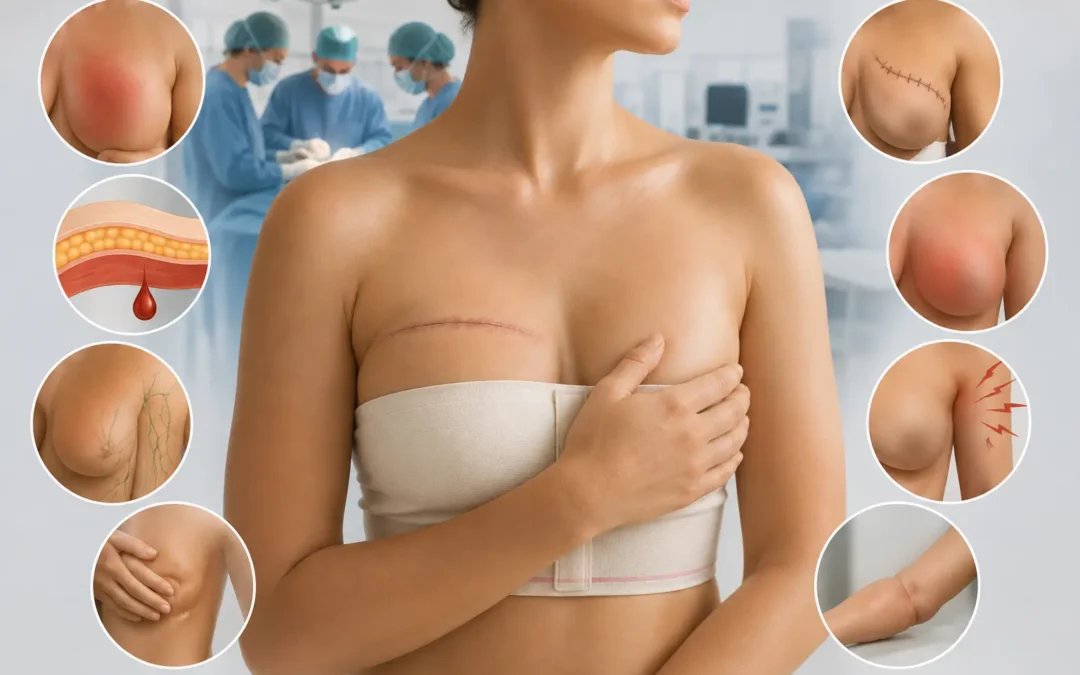
Breast cancer surgery carries risks that vary by procedure type lumpectomy, mastectomy, and axillary surgery each carry a distinct complication profile. Common risks include wound infection, seroma formation, bleeding, and nerve injury. Lymphedema remains the most significant long-term risk when axillary lymph nodes are removed. And while serious complications are uncommon, every patient deserves to understand them clearly before consenting to surgery.
According to Prof. Dr. Sandeep Nayak, Surgical Oncologist in India, Breast Cancer Surgery in Bangalore carries real procedural risks that differ depending on the surgical approach, and choosing the right technique for each patient is what keeps those risks low.
Concerned about which surgical risks apply to your specific diagnosis and stage?
What Are the Short-Term Risks After Breast Cancer Surgery?
Immediate complications develop within days to weeks of surgery and are largely manageable with prompt clinical attention.
- Wound Infection: Bacterial infection at the incision site affects roughly 3 to 15 percent of patients, presenting as redness, warmth, and discharge it’s treated with antibiotics or, in severe cases, surgical drainage, and diabetic patients carry a notably higher risk.
- Seroma: A seroma is a pocket of clear fluid that collects in the surgical cavity after tissue removal, and while it doesn’t usually signal infection, larger seromas need repeated aspiration to prevent discomfort and delayed healing.
- Bleeding: Post-operative haematoma, or pooling of blood under the skin, can occur within 24 to 48 hours and may require a return to theatre if the accumulation is significant enough to compress surrounding tissue.
- Anaesthesia Reactions: General anaesthesia carries its own risks including nausea, respiratory complications, and in rare cases adverse cardiac events, which is precisely why pre-operative medical clearance matters so much.
Most short-term complications resolve fully with standard post-operative care, and minimally invasive techniques reduce many of these risks compared to open surgery.
Explore the full range of types of breast cancer surgery to understand how the approach affects complication rates before deciding on a procedure.
What Are the Long-Term Risks of Breast Cancer Surgery?
Some complications don’t surface immediately they develop over months or persist for years and require ongoing management.
- Lymphedema: Removal of axillary lymph nodes disrupts normal lymphatic drainage and can cause chronic swelling in the arm, hand, or chest wall, affecting between 20 and 30 percent of patients who undergo full axillary dissection sentinel node biopsy significantly lowers this risk.
- Nerve Damage: The intercostobrachial nerve runs through the axilla and is frequently stretched or divided during lymph node surgery, leaving some patients with persistent numbness, tingling, or pain along the inner arm and chest that may not fully resolve.
- Shoulder Stiffness: Reduced range of motion in the shoulder joint is common after axillary surgery, particularly if rehabilitation exercises aren’t started early physiotherapy begun within the first two weeks post-surgery consistently improves long-term mobility outcomes.
- Scar Contracture and Altered Sensation: Surgical scars can thicken and contract over time, especially after mastectomy, and permanent changes in breast skin sensation or nipple sensitivity are expected whenever significant tissue is removed.
Long-term risks are real but not inevitable surgeon experience, technique selection, and post-operative physiotherapy all directly influence outcomes. For those concerned about what comes next, understanding whether breast cancer can return after surgery is often the most important question to address.
Why Choose Dr. Sandeep Nayak for Breast Cancer Care in Bangalore?
Dr. Sandeep Nayak holds MBBS, DNB (General Surgery), DNB (Surgical Oncology), MRCS (UK), and MNAMS qualifications, with over 20 years of surgical oncology experience and the K Subhramanyam Robotic Innovation Award 2023. As Executive Director of Surgical Oncology and Robotic Surgery at KIMS Hospital, he performs robotic and minimally invasive breast cancer procedures that demonstrably reduce complication rates compared to conventional open approaches
His patients don’t get generic reassurances. They get procedure-specific risk counselling, technique selection based on their anatomy and cancer stage, and a post-operative physiotherapy plan built in from day one.
FAQ
Is lymphedema permanent after breast cancer surgery?
Lymphedema can be chronic but is manageable with compression therapy, exercise, and physiotherapy.
Does a lumpectomy carry the same risks as a mastectomy?
No, lumpectomy carries fewer risks overall; mastectomy has higher rates of infection and reconstruction complications.
Can nerve damage from breast cancer surgery heal?
Partial recovery is possible over 12 to 18 months, but some numbness may be permanent depending on nerve involvement.
How can patients reduce their risk of post-surgical complications?
Maintaining a healthy weight, quitting smoking before surgery, and starting physiotherapy early all reduce complication risk.
References
- American Cancer Society – Post-Mastectomy Pain Syndrome
- PubMed / NCBI – Breast Surgery: Management of Postoperative Complications Following Operations for Breast Cancer
Disclaimer
This blog is shared for educational and informational purposes only. It isn’t a substitute for professional medical advice, diagnosis or treatment.